
Written by the party
Player Journals
Your players keep the campaign journal right on the map. They open a hex, write what they found, and the whole party sees it appear. You write the templates; they fill in the story.
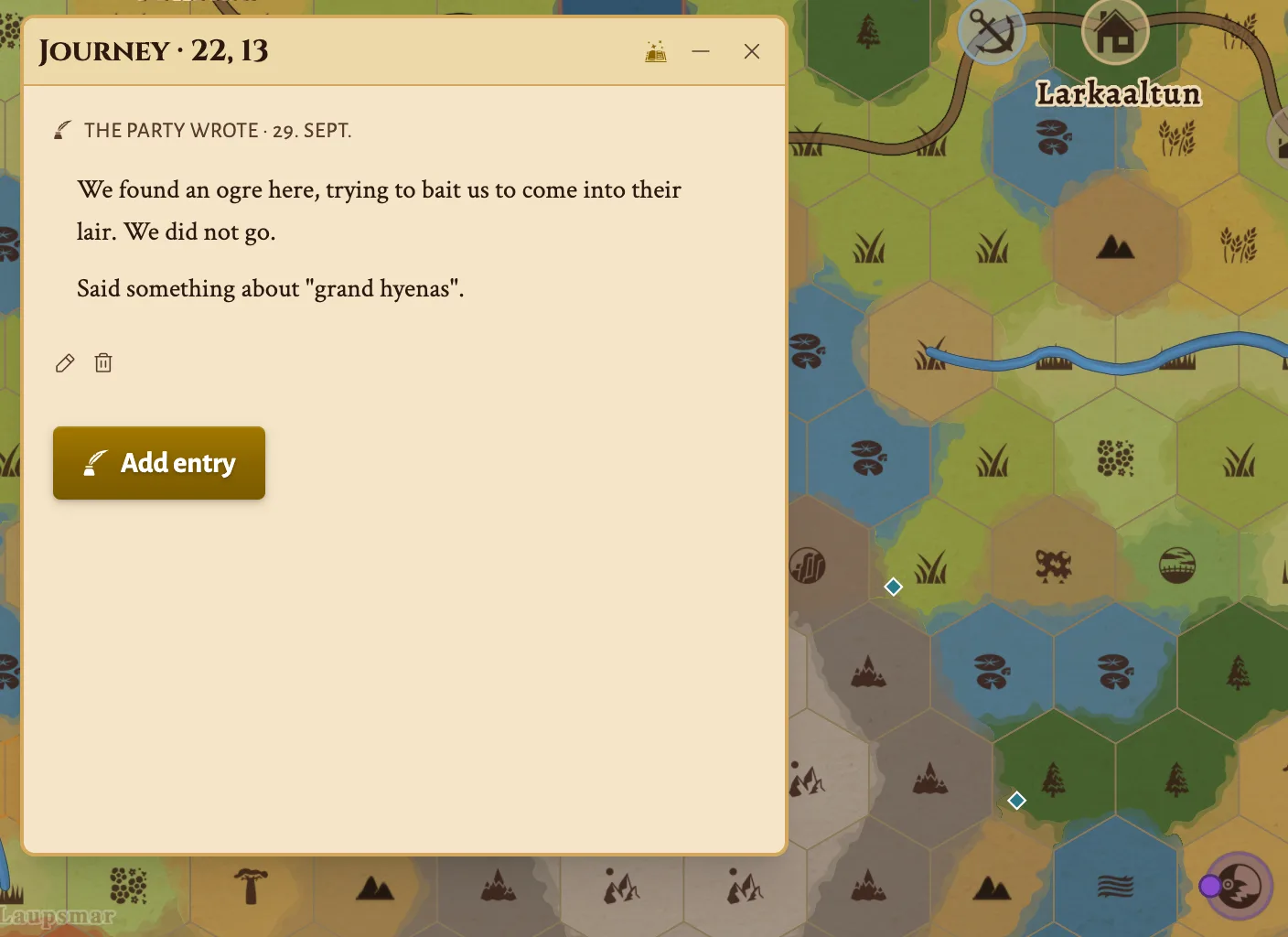
The party's memory, where it belongs
In a hexcrawl, the players' notes are the campaign. Which village sold them bad maps, where the ferry was burned, what the hermit said about the tower in the marsh. Kept in a chat log or a notebook, that record drifts away from the map it describes. Three sessions later nobody remembers which hex the hermit lived on.
A Hexer player journal pins each entry to its hex. The map becomes the party's own record of the journey, written in their words, and anyone can open a hex to read what the party knows about it.
How It Works
1. Switch on the journal when you share
In the Share dialog, allow the player journal and pick which of your templates this map offers. Choose whether players may write on any hex they can see, or only on hexes the party has explored.
2. Players write from the shared map
In the live shared view, a player opens a hex and starts an entry from a template or a blank page. The journal opens as a window they can move, resize and minimise, with the party's earlier entries for that hex still in view. A draft is kept per hex until they save it.
3. The whole table sees it
A saved entry appears for every connected player in real time, and a badge marks the hex so the party can find it again. No account is needed to read or write.
4. You review it in the editor
Every entry is visible in your editor. When a player writes something worth keeping, promote the entry into one of your own DM notes. Hide the journal badges from the View menu while you work, and bring them back to review.
Templates that fill themselves in
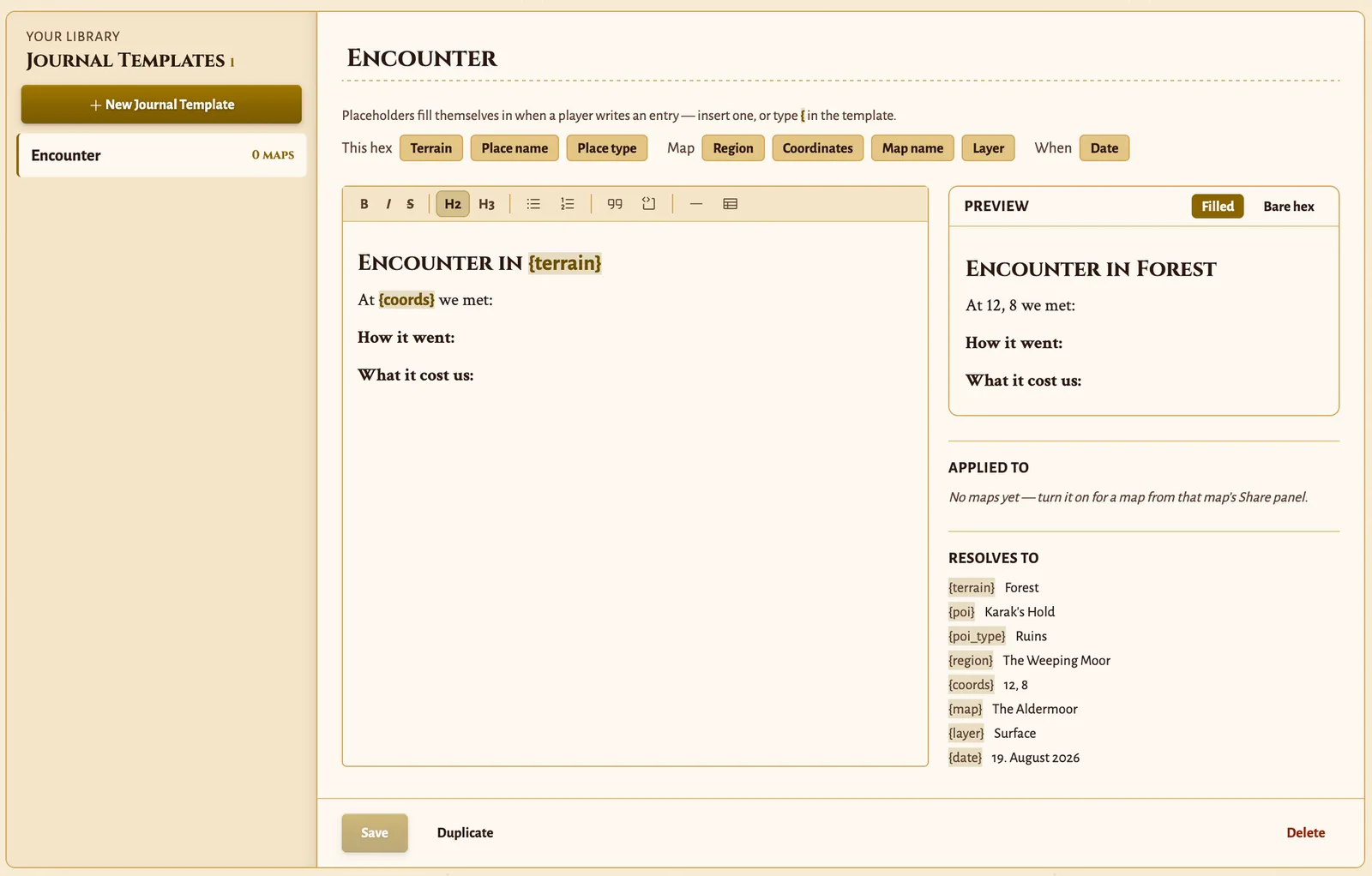
A journey-entry template is the text a new entry starts from, so every discovery is logged the same way. You write templates once, on their own page in your dashboard, and reuse them across maps.
Drop in a placeholder and it becomes the real value of the hex a player writes on: terrain, place name, place type, region, coordinates, map name, layer, date. Type { to pick one from a list. A live preview
shows exactly what players receive, including on a bare hex where a placeholder has nothing to fill in.
Starting from scratch? Hexer offers 4 ready-made templates — Arrival, Discovery, Encounter, Rumour — when your library is empty.
Part of the shared game
The journal follows the same rules as the rest of the player view. With fog of war, you can limit writing to hexes the party has explored, so the journal grows exactly as fast as the party travels. Move the party with a party token, and the hexes they reach open up for writing.
Entries on a zoomed-in scale level stay on that level, so a note about one farmstead does not end up on the whole province.
Start a Party Journal
Player journals are free: 50 entries per map and 1 template. Pro gives you unlimited templates and 5,000 entries per map.
Frequently Asked Questions
What is a player journal?
A shared campaign journal that lives on the hex map. In the shared view, players open a hex and write down what they found there. Every entry appears for the rest of the party in real time, so the table builds one record of the journey together instead of scattered notes in a chat.
Is the player journal free?
Yes. On the free tier a map holds up to 50 journal entries and you can write 1 template. Pro raises the limit to 5,000 entries per map with unlimited templates.
Do players need an account to write entries?
No. Anyone with the share link can read and write the journal once you switch it on. Entries are not signed — the journal belongs to the whole party.
Can players write on hexes they have not reached yet?
You decide. Allow entries on any hex the players can see, or, with fog of war on, only on hexes the party has explored.
What are journey-entry templates?
Templates are the starting text for each entry, so every discovery is logged the same way. They can fill themselves in: placeholders such as terrain, place name, place type, region become the real values of the hex a player writes on. If your library is empty, Hexer offers 4 ready-made templates to start from.