
Guide for Game Masters
Build Your Campaign World
From geography to politics to hidden secrets. A practical guide to building D&D world maps that serve your campaign, not just decorate it.
Watch procedural generation build a world in seconds.


Step 1 — Start with Geography
Every world starts with land and water. Before you name a single kingdom, decide where the continents, oceans, mountain ranges, and rivers are. Geography shapes everything else — trade routes follow rivers, cities grow at harbors, wars happen over mountain passes.
Think in broad strokes first:
- A mountain range splitting the map creates two distinct regions with different climates
- A major river flowing from highlands to coast becomes a natural trade corridor
- An archipelago off the coast invites naval adventures and pirate lairs
- A desert to the south means a different culture, different resources, different threats
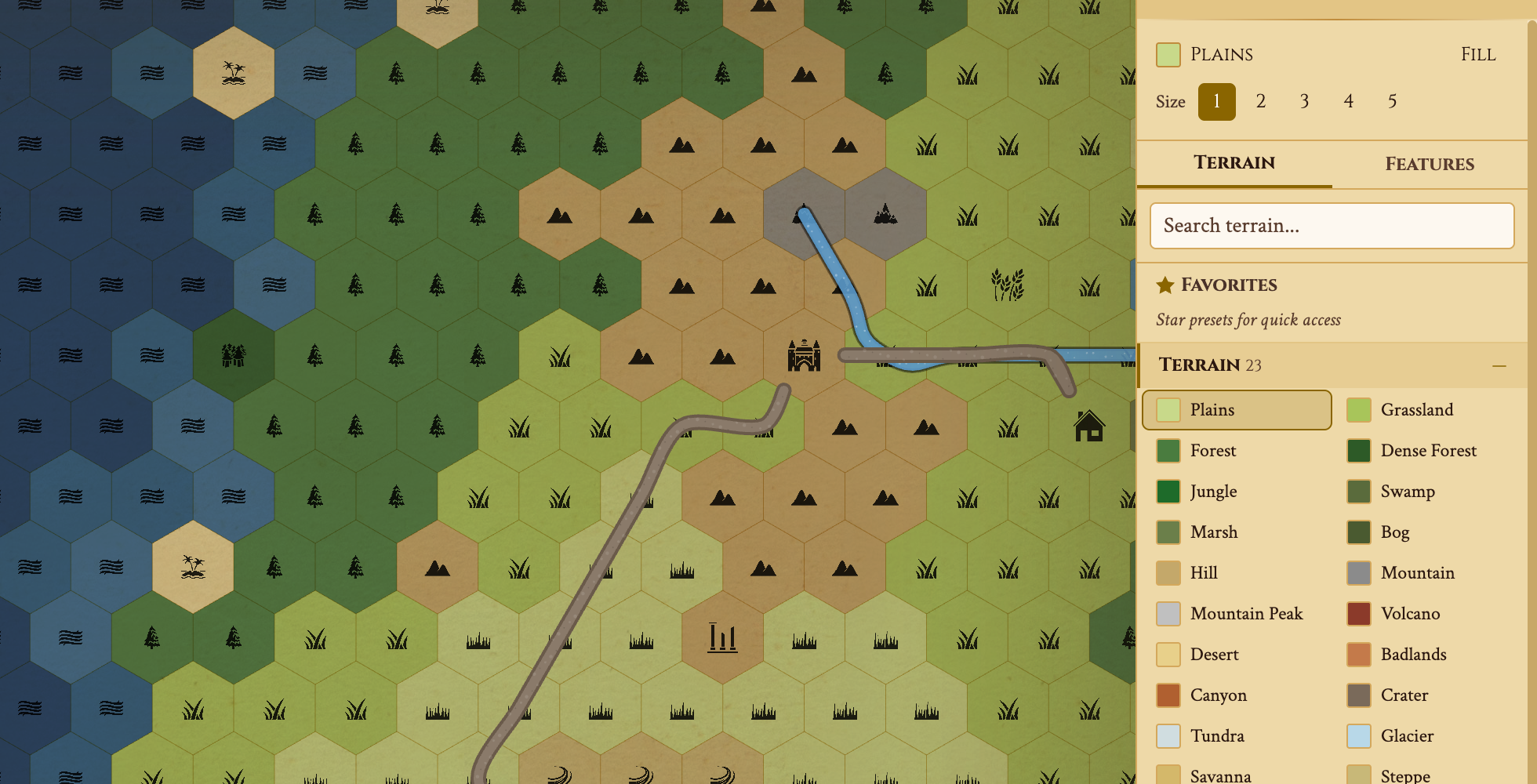
In Hexer, use the 41 terrain types to paint your geography. Forests, mountains, plains, deserts, oceans, swamps — all free. Place them in natural-looking patterns: forests at the base of mountains, swamps where rivers meet the sea, plains in the rain shadow of mountain ranges.
Step 2 — Use Procedural Generation as a Foundation
Building a world hex by hex takes hours. Hexer's procedural generator creates a realistic starting point in seconds — coastlines, mountain ranges, biome-aware terrain, river systems, and settlements.
Start from one of 7 templates, then adjust the land, climate, and peoples:
Island Kingdom
A lush island surrounded by deep ocean, with mountains at the center.
Continental
A large landmass with varied biomes, coastlines, and mountain ranges.
Archipelago
Scattered islands across a vast sea, connected by trade routes.
Frozen North
A cold, harsh tundra with glaciers, sparse forests, and mountain passes.
Desert Wasteland
A scorching desert with scattered oases, canyons, and ancient ruins.
Mythic Realm
A compact 12×12 realm of varied wilds and lonely landmarks, sized for knightly hexcrawl campaigns.
River Valley
Fertile lowlands between mountain ranges, crisscrossed by rivers.
The result is more than terrain: roads link the settlements, kingdoms claim territory with borders, every place gets a name, and each settlement and site comes with a DM-only note. On Pro, the generator can also dig cave levels beneath the surface.
After generation, hand-edit to match your vision. Move the mountain range, add an enchanted forest, delete a river that doesn't fit. The generator gives you nature; you add narrative.
Try painting terrain — pick a type and drag across hexes.
Step 3 — Place Settlements and Trade Routes
Settlements don't appear randomly. Cities grow where resources meet transportation — river junctions, natural harbors, mountain passes, fertile plains. Place your towns and cities where they make geographic sense.
Use Hexer's 38 map features to mark settlements, dungeons, sacred sites, ruins, and more. Then connect them with paths:
- Major roads between large cities — well-traveled, safer, faster movement
- Trade routes connecting resource-producing regions to markets
- Trails through wilderness — less safe, used by rangers and smugglers
- Rivers as natural highways — boats can carry goods faster than carts
Think about what each settlement exports and imports. A mining town in the mountains trades ore for grain from the plains. A port city imports exotic goods from across the sea. These trade relationships drive adventure hooks — bandits on the trade road, a blockade at the harbor, a drought threatening the grain supply.
Step 4 — Define Political Regions
Geography creates the land. Regions create the story. Draw named, colored regions to represent kingdoms, tribal territories, disputed zones, and wild lands.
Good regions create tension:
- Two kingdoms claiming the same fertile valley
- A free city surrounded by a hostile empire
- Tribal lands with no central authority — each hex might have a different leader
- A blighted zone spreading outward from a corrupted ruin
In Hexer, regions are independent of terrain — a single "Elven Dominion" region can span forests, rivers, and hills. Color-code them so the political landscape is visible at a glance. Region borders follow natural features: rivers as borders, mountain ranges as barriers, coastlines as limits.
Step 5 — Add Secrets and DM Notes
A world map without secrets is just a geography lesson. The best campaign worlds have layers of hidden content — dungeons, prophecies, political conspiracies, and ancient ruins that players discover through play.
Use Hexer's DM notes to attach campaign hooks to hexes:
- Encounter: "Dragon turtle nesting ground. Approaches ships within 2 hexes."
- Secret: "Hidden entrance to the Underdark beneath the waterfall. DC 18 Perception."
- Landmark: "The Weeping Colossus — a 200-foot statue half-sunk in the swamp. Who built it?"
- Quest hook: "The duke's missing daughter was last seen heading into the Thornwood."
Mark notes as DM-only so they stay hidden when you share the map with players. They see the terrain and paths; you see the secrets underneath.
Step 6 — Scale Considerations
The hex scale you choose changes how your world feels at the table:
6-mile hexes (campaign scale)
The D&D standard. A party on foot covers 3-4 hexes per day. Each hex is large enough for a village, a dungeon, or a notable landmark. A 40x30 map covers roughly 240x180 miles — enough for an entire campaign region. This is the most popular scale for hexcrawl play.
24-mile hexes (regional scale)
Good for zoomed-out continent maps where you want to show kingdoms and major geography. Each hex might contain several points of interest. Travel between major cities takes days, not hours. Best used alongside a 6-mile detailed map for the area where play actually happens — in Hexer, that can be a scale level of the same map.
1-mile hexes (tactical scale)
Close-up detail for a single valley, city surroundings, or battlefield. Good for focused scenarios where terrain matters hex by hex. A 40x30 map covers just 40x30 miles — a couple days' travel at most.
Start with a 6-mile hex campaign map. It's the most versatile scale and matches the movement rules in most tabletop RPGs. Hexer's free tier gives you a 40x30 grid — plenty for a full campaign. Pro extends up to 200x200 for massive worlds.
Start Building Your World
Hexer gives you everything you need — 41 terrain types, 38 map features, procedural generation, regions, DM notes, and live sharing. Free to start, no account required.
Frequently Asked Questions
What hex scale should I use for a D&D world map?
The D&D standard is 6 miles per hex. At this scale, a party on foot covers 3-4 hexes per day, making travel feel meaningful without being tedious. For a continent-scale overview, some DMs use 24-mile hexes (four 6-mile hexes across, sixteen by area). Hexer works at any scale, and with scale levels one map can hold both: zoom from the 24-mile overview into a 6-mile map of the region where play happens.
How big should a campaign world map be?
A 40x30 hex map at 6-mile scale covers about 240x180 miles — enough for a full campaign region. Most campaigns only explore a fraction of a larger world, so start small and expand. Hexer's free tier supports maps up to 40x30. Pro supports up to 200x200 for continent-scale worlds.
Should I use procedural generation or build by hand?
Both. Hexer's procedural generator creates a realistic foundation — coastlines, mountain ranges, forests, rivers, roads, settlements, and kingdoms with borders and names — in seconds. Then hand-edit to match your campaign vision: move that mountain range, add an enchanted forest, place a dungeon entrance. Generation gives you natural-looking geography; editing gives you narrative purpose.
Can I run a world-building session with players?
Yes. Share a live link and build the world while your players watch: every terrain change streams to their screens in real time. Players can't edit the map, but they can sketch on it (Shift and drag) to point at where they want a village or a mountain range, and you paint it in. After the session, add DM-only notes and secrets that players won't see.
What's the difference between regions and terrain?
Terrain defines what the land is — forest, mountain, desert, ocean. Regions define who controls it or what it's called — the Elven Dominion, the Blighted Wastes, the Free Cities. In Hexer, regions are named, colored overlays that span multiple hexes. They're independent of terrain, so a single region can contain forests, plains, and mountains.